
Fuel leaks caused by an unexpectedly strong harmonic response caused the loss of the SpaceX Starship during a test flight last month as the company prepares for its next launch.
In a statement released on February 24, SpaceX provided new details about the seventh Starship/Super Heavy test flight on January 16, which ended with the Starship’s upper stage breaking apart over the Caribbean Sea.
According to SpaceX, there was a flash in the aft section or “attic” of the Starship near one of its six Raptor engines about two minutes after the vehicle separated from the super heavy booster. After that, pressure rose in the section, indicating a fuel leak.
About two minutes later, there was a second flash, after which “constant fires” began in the attic.
“This ultimately caused all but one of Starship’s engines to perform controlled shutdown sequences, resulting in a loss of communication with the spacecraft,” the company said, with the last telemetry received approximately 8 minutes and 20 seconds after launch.
Causes of the Starship crash
SpaceX noted that the telemetry was lost before the ship’s autonomous flight termination system was activated. Instead, this system activated about three minutes after the vehicle lost communication.
The company concluded that the most likely reason for Starship’s loss was “a harmonic response several times stronger during flight than observed during testing, which resulted in increased stress on the propulsion system hardware.” This increased stress caused a fuel leak that could not be fully removed from the loft, resulting in fires that led to an engine shutdown.
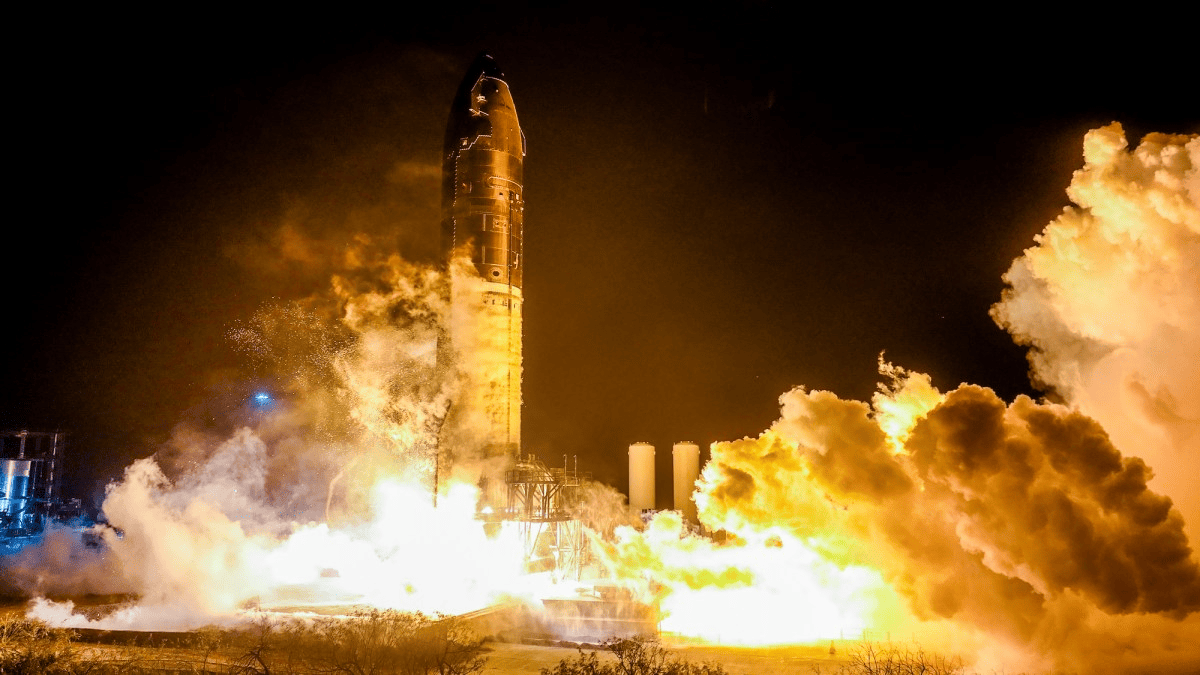
As part of the investigation, SpaceX conducted an extended static fire of the Starship built for the next mission, Flight 8, by running its engines for 60 seconds during a test on February 12.
“The 60-second run was used to test multiple engine thrust levels and three separate hardware configurations in the Raptor vacuum engine power lines to replicate and examine the harmonic response observed during Flight 7,” the company said. “The static fire findings indicate changes in the hardware of the vacuum engine fuel supply lines, fuel temperature adjustments, and a new target operating thrust that will be used during future flight tests.”
Preparing for your next flight
SpaceX said it is also adding vents and a nitrogen gas purge system to reduce the flammability of the attic portion of the current version of the Starship.
SpaceX is moving forward with the next Starship mission, Flight 8. It is scheduled to launch on February 28 from the company’s Starbase in Boca Chica, Texas, pending approval from the Federal Aviation Administration regarding SpaceX’s investigation into Flight 7.
SpaceX said that Flight 8 would have many of the same objectives as Flight 7 that were not demonstrated, including deploying four massive Starlink next-generation satellite simulators to test the vehicle’s payload deployment system. Starship will also test new technologies for re-entry protection, such as active-cooled metal tiles.
SpaceX will try to “catch” the super heavy launch vehicle on the Starbase launch tower, as on the previous flight. The booster includes changes such as updated avionics and power distribution systems, as well as updated ignitors for the Raptor engines to address the Flight 7 issue, in which one of the 13 engines shut down during ignition while backing up to return to the launch site.
“The seventh flight test of the Starship was a reminder that developmental progress is not always linear, and putting flight hardware in the flight environment is the fastest way to demonstrate how thousands of different parts come together to reach space,” SpaceX said in its Flight 7 recap.