
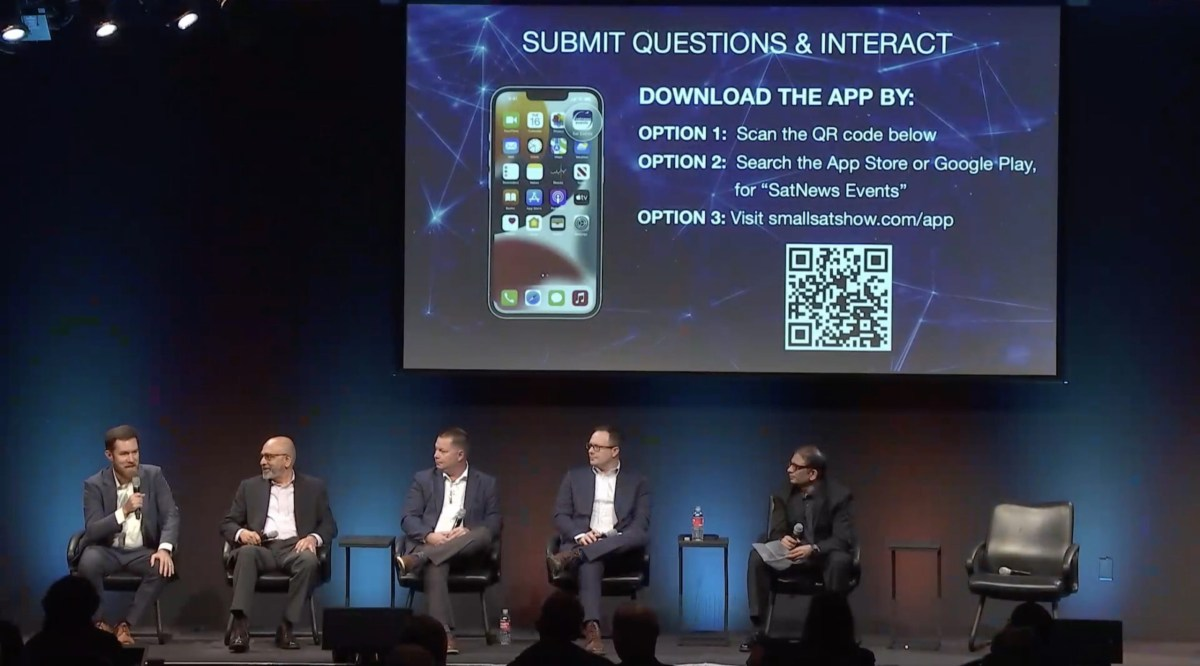
Parallels with the aviation and maritime industries offer essential insights into managing increasingly congested orbits, according to a panel of space technology executives at the SmallSat Symposium in Silicon Valley on February 6.
“We now have more than 10,000 satellites, which are projected to double every 22 months,” said Ahsun Murad, CEO of Optimal Satcom, a satellite networking company, potentially leading to ‘about 100,000 satellites in seven years’ amid insatiable demand for connectivity.
Rajiv Gopal, vice president of advanced defense programs at Hughes Network Systems, said there are also about 100,000 ships in the oceans and between 30,000 and 40,000 commercial aircraft operating around the world.
“There are accidents here and there, but for the most part, they work,” Gopal said,” but it also took us decades and centuries to develop these rules.
Tim Lynch, senior vice president and chief strategy officer of radiation-shielded electronics supplier Frontgrade, pointed out that many ships and aircraft are equipped with universal sensors for location, communications, and other critical data.
“I’m not saying it’s the solution, but it’s something to look at…we need to mature just like we did in space,” he said.
While companies like LeoLabs use ground-based radar to track objects in orbit, Lynch said the ability to manage space traffic through observation alone has limits.
“There’s going to have to be automation on the satellites,” he said,” and they’re going to have to communicate with each other so they can maneuver effectively, kind of like a turn signal in your car – someone sees the turn signal and realizes you’re turning.
Louis Christen, senior director of Northrop Grumman Space Systems’ Distributed Systems Operations Division, said the companies are currently working closely with space trackers from the 19th Space Defense Squadron of the US Space Force to prevent collisions and analyze the connection.
“But this work is going to get harder and harder as things get denser,” Kristen continued. “I think autonomy is going to become very critical here soon.”
New vulnerabilities
Along with the increase in the number of satellites, the growing number of debris creates challenges that current tracking systems cannot fully address.
The publicly available catalog in Low Earth Orbit (LEO) includes about 13,000 pieces of debris, as well as countless smaller fragments that are too tiny to track but still pose a threat to space operations.
Although LEO satellites are increasingly equipped with a propulsion system for mobility, Christen compared their thrust to a piece of paper resting on your hand.
“So we can’tdon’t get out of the way quickly,” he said, making autonomy even more critical in increasingly crowded orbits.
While the number of satellites is approaching the scale of airplanes closer to Earth, LeoLabs founder and COO Dan Caperly noted that the average convergence rate of any two objects in LEO is 12 kilometers per second.
“We’re getting similar numbers, but much faster,” he said.
The group also emphasized the growing risk of hostile activities in space, which is facilitated by technological advances that allow for close-range operations.
Satellite operators must reduce the risk of accidental collisions and protect against deliberate threats.
Seperley said that LeoLabs monitors the possibility of “nesting” in orbit, where one spacecraft deploys a second satellite, which then deploys a third.
This emphasizes the need for continuous and more frequent monitoring of orbital activity.
“At the moment, there are big gaps in the coverage of space awareness systems,” he said, adding that in just a few hours, a spacecraft can deploy additional satellites that separate and become undetected or unconnected.
“A few years ago, there was a zombie satellite that was declared dead about six years ago, woke up, did a big maneuver, stopped near some other Russian satellites, and went on to practice a series of rendezvous operations,” Seperley added.
This raises concerns about other unobserved objects lingering in the debris.
However, the expert group emphasized cybersecurity as one of the biggest threats to orbital operations, mainly because of its relatively low barrier to entry.
“You could have a kid in Starbucks and a laptop start attacking your satellite,” Frontgrade’s Lynch ironically said.
But while the development of computing has created new risks for an increasingly connected world, it also provides the tools necessary to strengthen offline defense against cyber and physical threats.