
NASA has selected SpaceX to launch a small science mission to exoplanets as a shared payload as early as September.
NASA announced on February 10 that it had awarded SpaceX a task order to launch the Pandora spacecraft. The task order is being executed through a venture-class Acquisition of a Dedicated Rideshare (VADR) launch services contract designed for smaller missions with a higher level of risk acceptance.
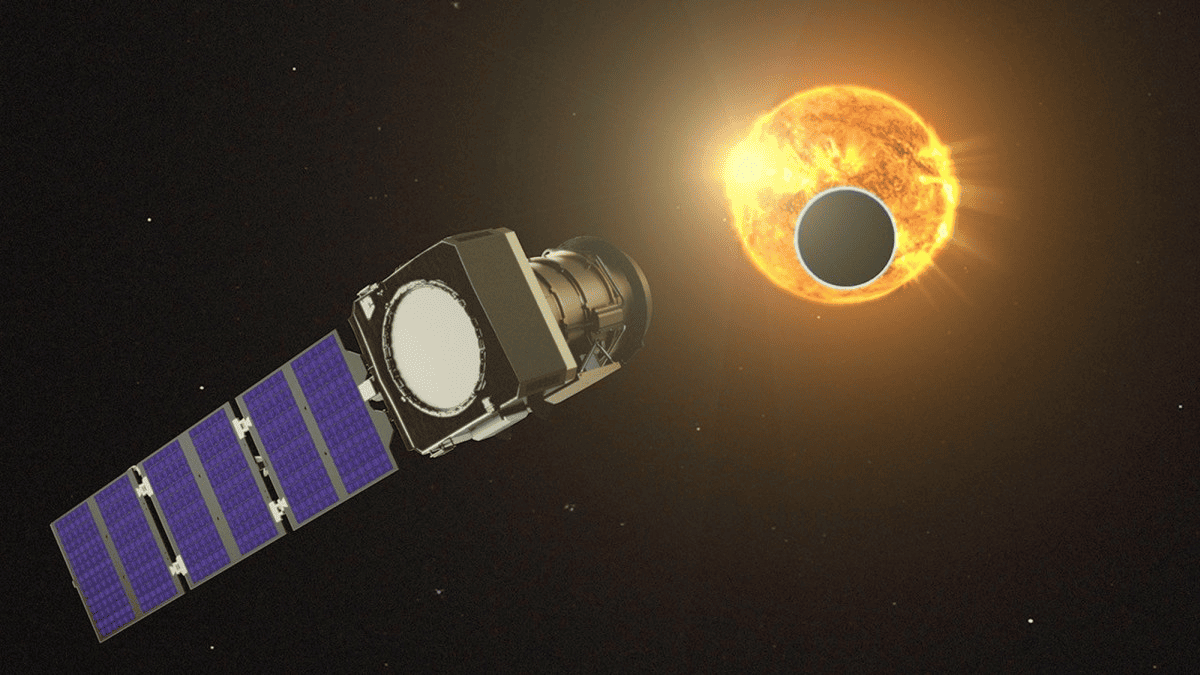
Pandora is a small satellite mission part of the agency’s Astrophysics Pioneers program for low-cost small satellites. The spacecraft has a 45-centimeter telescope equipped with optical and infrared detectors. During the one-year mission, it will observe 20 stars known to have exoplanets.
“Pandora’s primary goal is to study the atmosphere of exoplanets using transmission spectroscopy,” said Elisa Quintana, Pandora’s principal investigator, during a January 11 presentation of the mission at the Exoplanet Exploration Program Analysis Group (ExoPAG) meeting.
Pandora is designed to help scientists determine whether spectral signatures observed on certain exoplanets are caused by the presence of hydrogen or water in the planets’ atmospheres or are due to the star’s variability.
“Stars are not the same,” she said. “Pandora is essentially a calibration tool to help solve this problem.”
NASA announced on January 16 that the spacecraft bus for this mission is ready, so the mission is ready to launch in the fall. NASA’s announcement of the launch contract does not mention a launch date, but Quintana said at the ExoPAG meeting that they plan to launch as early as September as a shared payload.
Pandora is an ESPA Grande class spacecraft, a category that includes spacecraft weighing up to 320 kilograms, and is designed to operate in sun-synchronous orbit. This suggests that Pandora may launch a series of specialized missions on the SpaceX Transporter that send payloads to such orbits, but neither NASA nor SpaceX has disclosed details.
NASA’s announcement also did not disclose the value of the order to SpaceX. The agency routinely refuses to disclose the value of the VADR task order, claiming that such information is confidential, although the agency does disclose the value of more traditional launch contracts.