
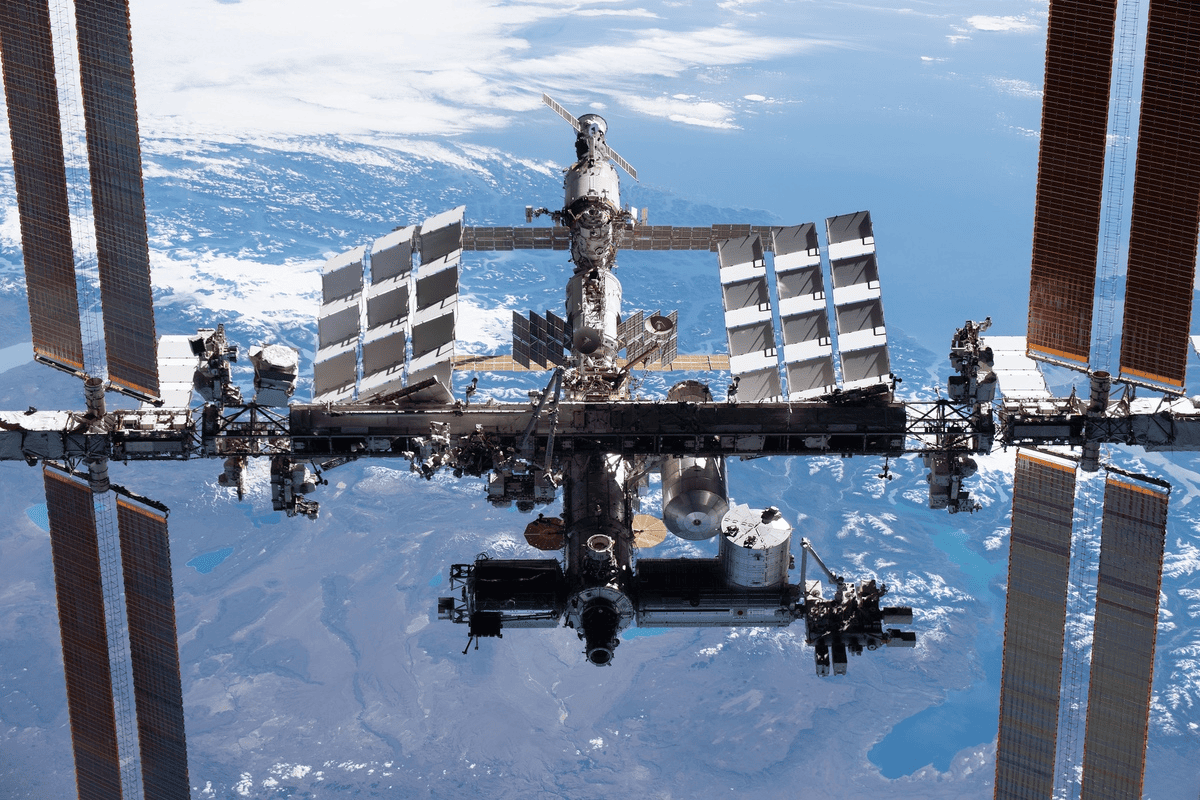
SpaceX CEO Elon Musk said that NASA should deorbitalize the International Space Station “as soon as possible, ” preferably within the next two years, to focus on missions to Mars.
Musk’s sudden social media call on February 20 to end the ISS several years earlier than NASA plans threatens to further complicate the relationship between Musk, a close adviser to President Donald Trump, and the space agency, as well as much of the space industry.
“It’s time to start preparing for the disruption of @Space_Station,” Musk posted on the social media network X, which he owns. “It has fulfilled its purpose. The additional utility is tiny. Let’s go to Mars.”
Asked to clarify whether this means the ISS will leave orbit earlier than 2030, Musk said it should cease operations in two years, NASA’s current date for decommissioning the station.
“The decision is up to the president, but my recommendation is as soon as possible. I recommend in 2 years,” he wrote.
These comments and Musk’s influence in the administration threaten to upend NASA’s plans for the ISS. These plans call for the station to operate until 2030 when the agency expects at least one commercial space station to be ready. This is so that NASA can continue the research and technology activities it currently conducts on the ISS.
As part of this effort, NASA awarded SpaceX an $843 million contract in June 2024 to develop a spacecraft called the United States Deorbit Vehicle (USDV) based on the company’s Dragon spacecraft. The USDV docked with the station and performed the last maneuvers necessary to deorbit the station over the uninhabited territory of the South Pacific. To minimize any risk of damage or injury to the population.
The spacecraft launched at the station about a year before its scheduled de-orbiting. In the USDV procurement, NASA has stated its preference for the USDV to be delivered for launch as soon as possible in August 2028, with a requirement that it be delivered no later than May 2029. It is unclear whether the development of the USDV can be accelerated to meet Musk’s goal of de-orbiting in 2027.
Concerns about the solution
An early exit from orbit will also complicate relations with other ISS-related companies and organizations, the space station’s commercial successors, and the station’s international partners, who have committed to participating in the ISS until 2030.
One particular challenge is that an early ISS de-orbit will almost certainly mean a gap in the continued presence of U.S. humans in low Earth orbit. This goal of NASA’s LEO microgravity strategy was released in December. This supports what is called a “continuous heartbeat,” i.e., the continuous presence of humans in orbit. NASA has previously discussed overlap between the ISS and commercial stations to ensure an orderly transition of research and equipment.
There are doubts in the industry whether any commercial space station could be ready by 2030, which could force NASA to accept a gap or further expand the station. However, the station’s designers remain confident: Vast recently outlined plans for a permanent crewed station, which, according to its forecasts, will be ready by 2030. Axiom updated its plans in December for a station that will be able to support crews as early as 2028.
Last week, key members of Congress reaffirmed their desire to maintain a permanent U.S. presence in LEO.
“Abandoning LEO in a well-intentioned but misguided effort to focus on the Moon alone or Mars alone will only allow China to fill that void, driving a wedge between the United States and our partners,” said Senator Ted Cruz (R-Texas), chairman of the Senate Commerce Committee, at the Commercial Space Conference on February 12. “That’s not a path we’re going to go down.”
He then said that the ISS should continue to operate until commercial successors are ready.
“We’ve invested over $100 billion in the International Space Station, and it would be extremely foolish to prematurely send all that infrastructure and all those tax dollars to the bottom of the ocean.”
Representative Brian Babin (R-Texas), Chairman of the House Science Committee, made similar comments at the conference.
“The International Space Station is clearly a technological marvel, and it has served us well for many decades,” he said. “We need to think carefully about how the International Space Station and future commercial platforms will play a role in achieving the United States’ goals in low Earth orbit.”
It is not known what prompted Musk to call for an early end to the ISS. SpaceX is a large company that supports the station’s operation by providing NASA astronauts with the main means of getting to and from the station and transporting cargo.
However, Musk’s comments came hours after he lashed out at European Space Agency astronaut Andreas Mogensen. He visited the station on the Crew-7 mission, using Crew Dragon, from August 2023 to March 2024. In a post on X early on February 20, Mogensen criticized Musk for comments made in a television interview on February 18. They claimed that NASA astronauts Butch Wilmore and Suni Williams were left on the ISS for political reasons by the Biden administration. Neither Musk nor the others provided any evidence to support this accusation.
“What a lie,” Mogensen wrote.
Elon Musk responded by using even harsher language in a post to describe Mogensen. Musk claimed that SpaceX had offered to return Williams and Wilmore sooner but that the Biden administration refused. He did not provide any further information on the offer. Neither he nor SpaceX, nor NASA, nor the former Biden administration had previously disclosed any information.
Less than two and a half hours after his response to Mogensen, Musk released his call for a quick exit from ISS orbit.