
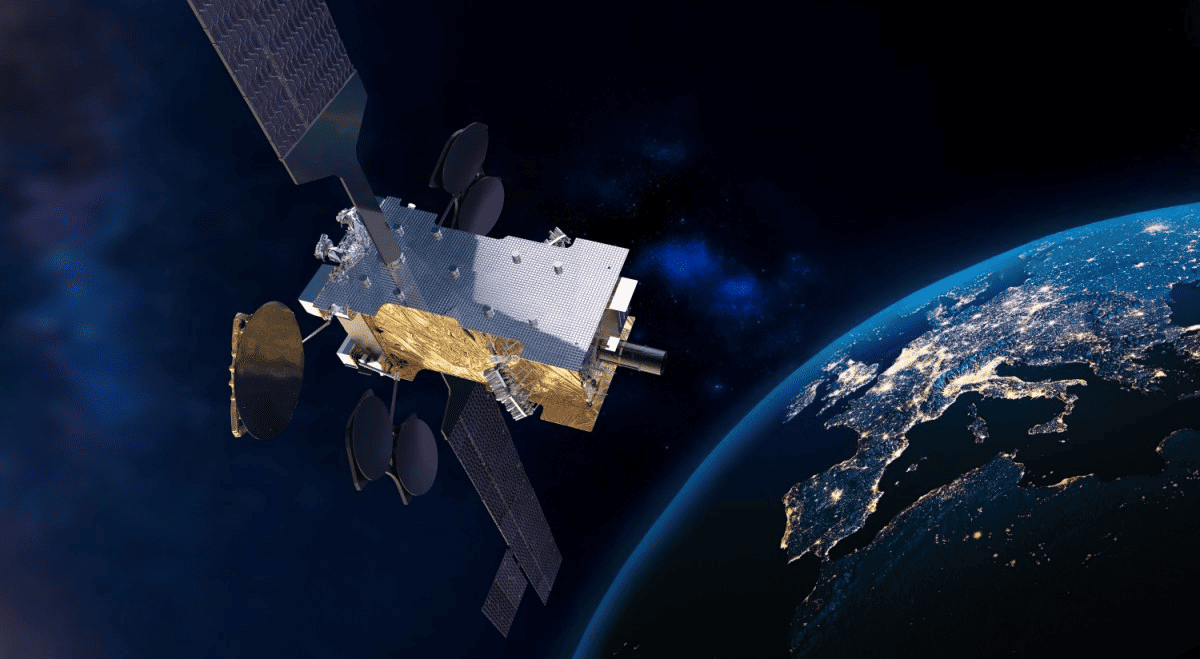
European satellite manufacturer Thales Alenia Space and Spanish operator Hispasat have secured government funding to develop a geostationary payload that uses quantum technology to distribute encryption keys.
The companies said on January 21 that the two-year project, initiated by Spain and supported by 104 million euros ($108 million) in European COVID-19 recovery funds, is paving the way for the first quantum key distribution (QKD) platform to operate from a geostationary device.
The QKD-GEO mission builds on efforts in low Earth orbit (LEO) to make communications more secure by exploiting the behavior of subatomic particles, including the SES-led Eagle-1 project, which was initially launched last year but is now targeting late 2025 or early 2026.
QKD uses the quantum properties of photons to create encryption keys that cannot be intercepted without changing their state. Any eavesdropping attempt disrupts the quantum state of the photons, rendering the keys unusable.
Although terrestrial fiber optic networks can distribute quantum keys, their range and speed are limited. Current fiber-optic technology cannot support quantum communication over distances of more than a few hundred kilometers due to signal loss, Thales Alenia Space and Hispasat noted in a joint press release.
Satellites can overcome these limitations because signals experience less fading in free space.
The companies add that a single geostationary satellite at a distance of 36,786 kilometers can also provide continuous communication between continents without requiring complex signal-tracking systems. In contrast, QKD systems in LEO will require multiple satellites and frequent switching to maintain coverage.
Hispasat CEO Miguel Panduro said, “establishing encryption keys using the quantum protocol will mean a paradigm shift for secure communications of the future, where space and satellites will be configured as the ideal infrastructure for their long-distance transmission.”
In 2022, Hispasat led a team that included Thales Alenia Space to study the feasibility of this mission. The QKD-GEO contract also provides for the development of the ground payload segment.
A Thales Alenia Space spokesperson said the current plan is to place the QKD payload on a Hispasat satellite.